

Made of melted snow, the Callery River tumbles cold and cobalt from the ramparts of South Westland’s Main Divide. There’s no such thing as easy country here: the river squirms between flanks so steep that the contour lines on a topomap form solid blocks of orange. You might call it ‘tiger country’. It used to be rat, stoat and possum country too. But no longer.
The Callery Valley scribes a scythe inland of Waiau/Franz Josef. It is a battle front: the southern edge of Aotearoa’s biggest restoration project, Predator Free South Westland (PFSW). For years now this valley, along with some 110,000 adjacent hectares, has been nominally pest-free. Nominally, because the lands outside are still lousy with them, which is why Zero Invasive Predators (ZIP) doesn’t say ‘eradication’. Instead, it talks about ‘elimination’, which recognises that if you remove all their competition, and make thousands of new birds and berries and lizards and insects, you just created a rat’s idea of heaven, and it wants in. You will be dealing constantly with what pest managers call ‘incursions’. Somehow, then, you need eyes on your borders. They must be wide open, day and night.
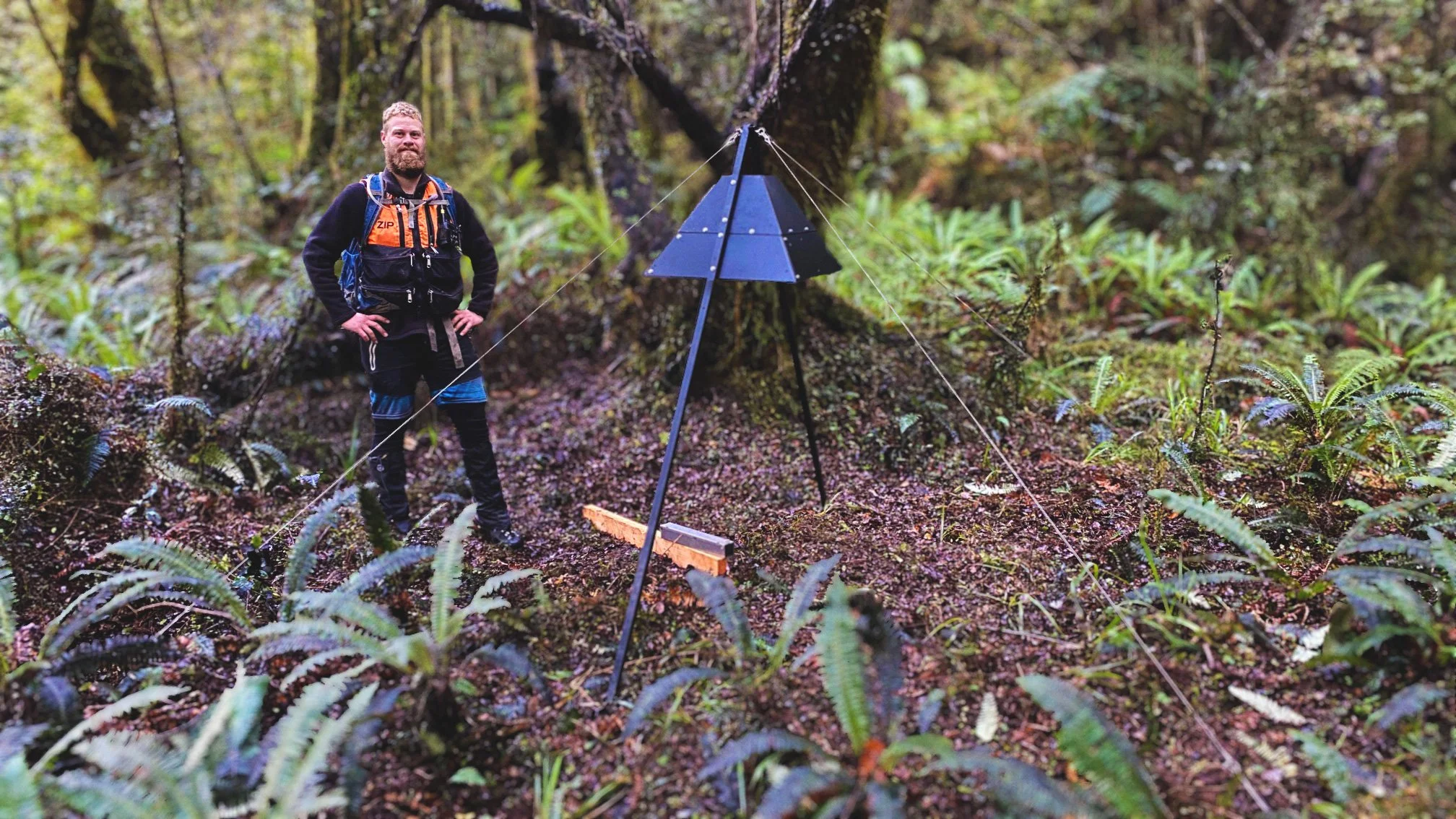
Field Ranger Chad Cottle with a ZIP AI Camera (Mark 2)
That used to mean a team of hardy rangers like Chad Cottle trudging the backblocks on endless loop, servicing many hundreds of remote trail cameras across PFSW. ‘Trail cameras are great, but they have their downsides,’ says Cottle. ‘That became clear as we expanded our monitoring from 10,000 to 100,000 hectares.’ Trail cameras take a photograph whenever something moves. That might be a rat; more often, it’s a branch waving in the wind. The rangers had to visit each camera every six to eight weeks, change its battery, and replace an SD card that might hold more than 300 pictures. Then they’d spend their nights in backcountry bivvies trawling through those images, just in case one of them had a predator in it. Those grinding logistics, says Cottle, ‘meant a rat could’ve been at large in PFSW for up to nine weeks before anyone knew.’ That’s long enough to bear and raise 10 pups.
It’s a hard way to get to Predator Free; it takes too long, and it costs too much. Development engineer John Wilks pondered a better way.
Conventional cameras weren’t going to cut it. ‘In the visible spectrum’, he says, ‘a rat in the forest presents as a browny-grey mottled thing against a browny-grey mottled background.’ And to make things worse, rats usually get around at night: ‘If you want to use visual spectrum cameras at night, you have to flood the area with far infrared light.’ Rats’ retinas lack the cones needed to ‘see’ infrared light, but studies overseas have suggested they might still be able to perceive it somehow. ‘Our observations from trail cameras were that some rats could see far infrared lighting,’ says Wilks. ‘They would even startle.’
The solution lay in a different dimension—heat. ‘The bush is fundamentally cold and uniform’, he explains, ‘especially at night. We needed a device that would know when something warm shows up.’
ZIP's AI Thermal camera compares the images it's getting with a trained AI database, to give rangers an estimate of confidence in its identification. In this footage, it's correctly identified a possum and a rat.
Now, when a rat breaches the borders of PFSW, it will encounter a network of much smarter sentinels. An automated mayonnaise treat dispenser entices it within range of infrared sensors, which pick up the heat from its body. Then they wake up an AI thermal camera which starts recording what it’s seeing. The rat’s heat signature, says Wilks, ‘maximises the contrast between the animal and the background.’
The cameras look straight down from 1.5m above. That standardised scale, he says, helps with accurate identifications: ‘rats and mice can look deceptively similar in the thermal spectrum, depending on their distance from the lens.’
Thanks to that lucid image and machine learning, the camera can tell a rat from a rowi, a stoat from a skink, a possum from a parrot. Once it has a positive ID, or even a pretty sound bet, the camera will raise the alarm over a radio network to a nearby remote comms base station. The base station is a relay, passing the camera’s alert to the 4G cell network, which in turn beams it to a web server. Nowadays, grids of AI thermal cameras keep watch every night, alerting rangers to any incursions with an image of the intruder and the A.I’s estimate of its own confidence in the ID.
‘One of the toughest nuts to crack’ says Wilks, ‘was designing an energy-hungry device sending data-heavy images to run on very low power using batteries—shady bush isn’t great for solar power’. So the camera is only live when the heat sensors wake it, and it sends only small packets of data over low-power radio networks. That means an AI Thermal camera can stay vigilant for nine months.
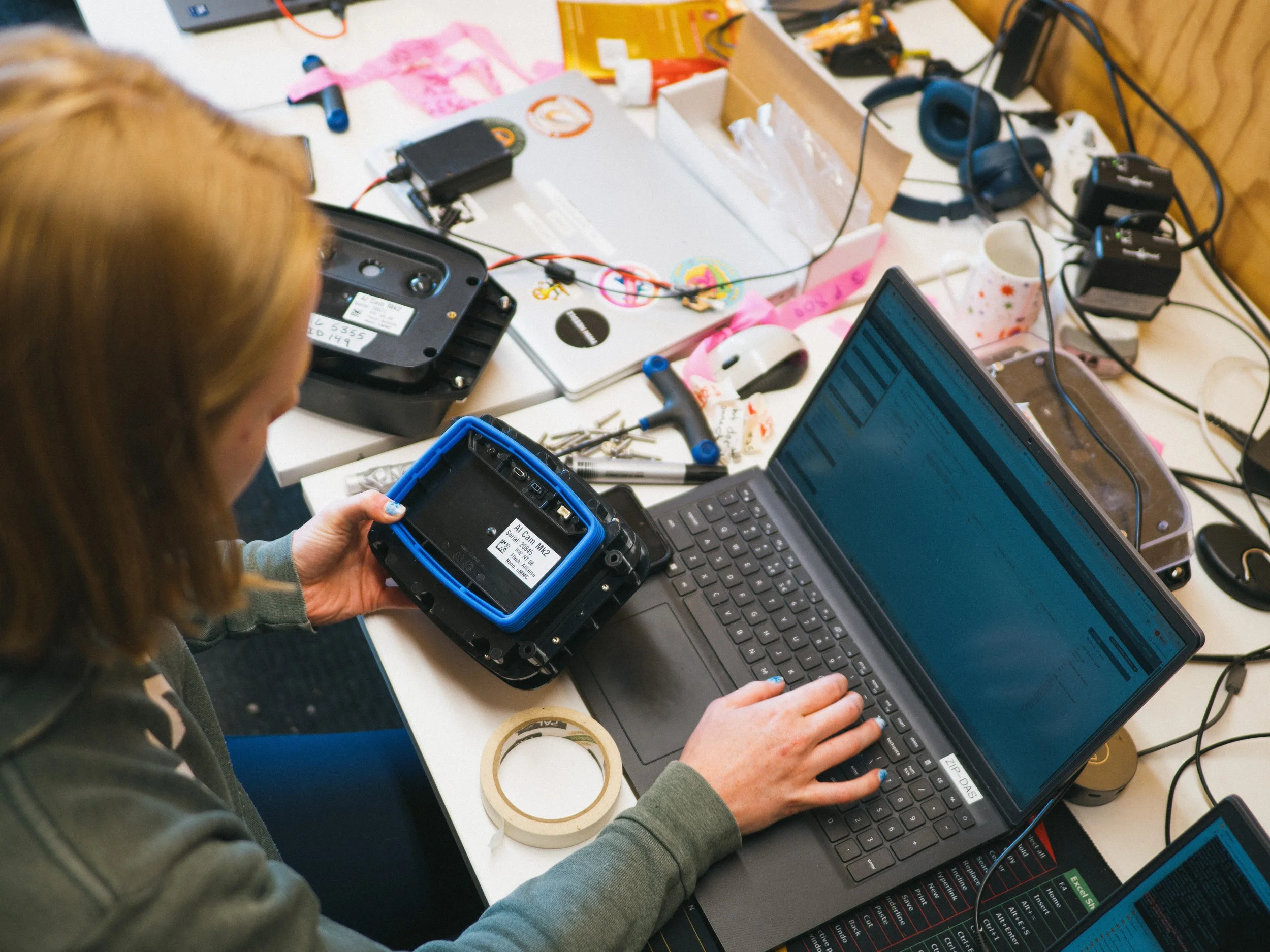
A ZIP field ranger testing an AI camera before it goes out back out into the field.
Predator Free 2050 is often pitched as a quest for new ways of killing things, but ZIP’s technical director Phil Bell knows the real holy grail is spotting things that are still alive and well. ZIP’s thermal AI camera is what had to happen before anyone could even dream of pest elimination across big landscapes: ‘To operate over hundreds of thousands of hectares—let alone the millions we need to get to—we need to automate at the same scale. Detection is a fundamental part of the predator free model, and the AI camera has massively reduced the labour demands of doing it. That means we can watch much bigger landscapes than we ever have before.’

Field Team Lead Bradley Shields explaining an active AI camera in Ōkārito
ZIP now has more than 1000 AI cameras on duty in Predator Free South Westland, with another 500 on the way. Just over the Main Divide at another Predator Free project, Te Manahuna Aoraki, it’s deployed 150, and plans to put out a further 120 by summer’s end, 2027.
ZIP’s AI Thermal camera is now in its third evolution, but R&D is never done: v.3 is dramatically smaller than its predecessor, but Bell wants to see it get ‘smaller, cheaper, and even longer lasting without us needing to touch it. We’re working on extending the battery life still further, and boosting the processing power, so that it needs less servicing from our team.’
The kūmara prank
After two weeks at Scone Hut, beside the remote headwaters of the Perth River, Nate St Hill was getting bored. Preparing dinner, he tossed a kūmara into a pot of boiling water, and a smile came to his mind. It was high time for a prank. He and co-conspirator Jono Dobbs tied a string around the hot kūmara, and carried it outside.
Not far from the hut was an early iteration of a ZIP AI thermal camera, and the pair knew it was being monitored. Taking the kūmara by its leash, St Hill led it slowly and with deliberate care between the camera’s steel legs. Inside the device, a pair of infrared sensors perceived...
On the other side of the main divide, in Christchurch, development engineer John Wilks got an alert on his computer. The camera had photographed the heat signature of what he recalls was ‘a pretty crappy-looking rat. The weird thing was that ordinarily, a rat’s head is warmer than its body, thanks to all the brain activity going on in there, but this one was warm all over.’
All the same, he called Dobbs next morning to let him know he had a rat incursion to deal with. ‘When he mentioned this location,’ recalls Dobbs, ‘I realised he’d found the kūmara. I couldn’t stop laughing, but John took it in good jest.’
The hoax eased the rangers’ boredom, but it proved something valuable too; the camera, the radio network, and their human overseer had all done their job. The system worked.
‘If I had my time again,’ says St Hill, ‘I’d take the temperature down a notch, as the kumara looked a little whiter in the thermal image than a real rat, but it was enough to prank John, so it was close enough.’