
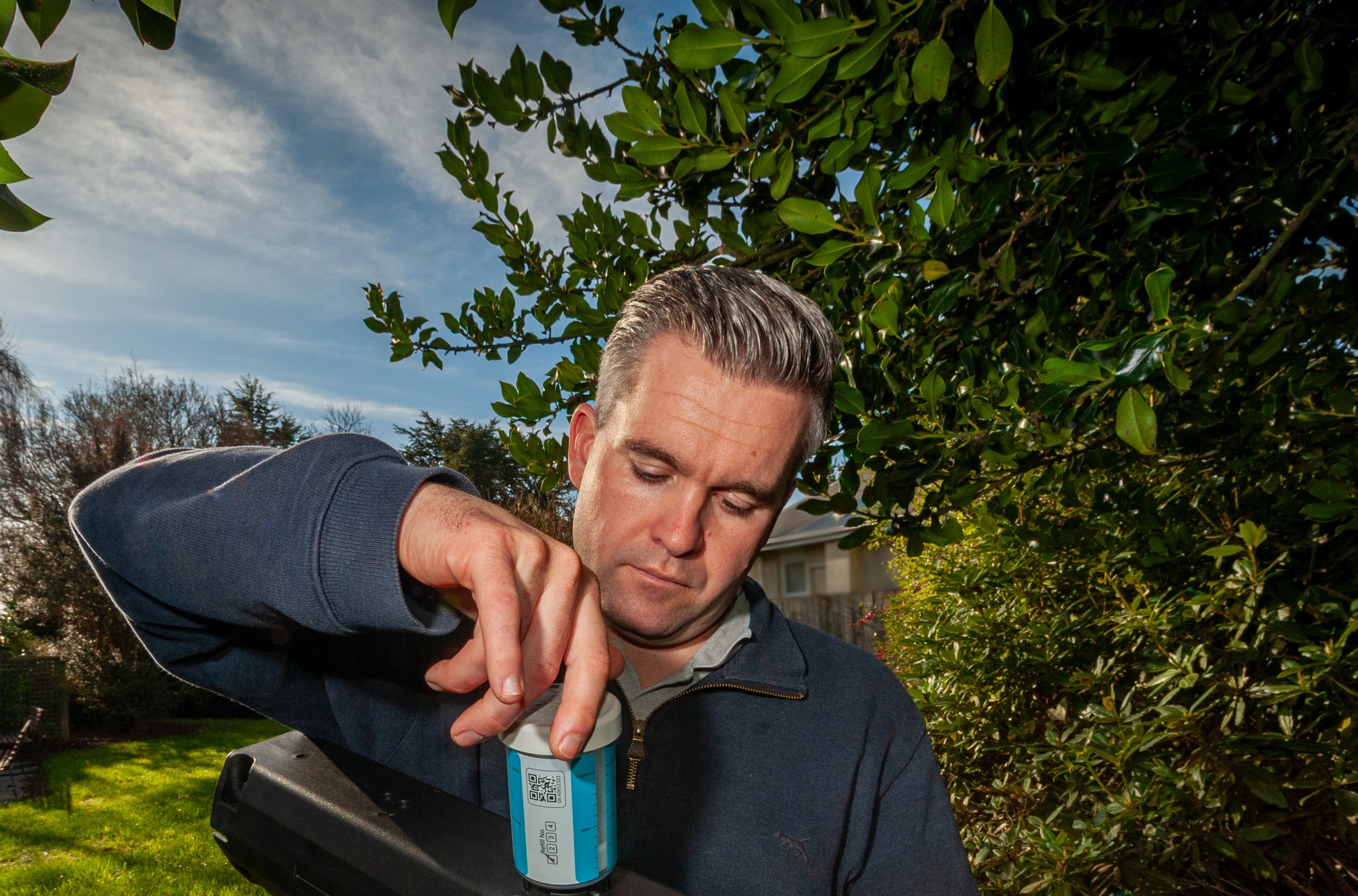
It’s the most abundant element in the universe, but just a tiny breath of hydrogen is a tailwind driving Predator Free 2050.
Funny how revolutions often don’t look like one. Tom Agnew is holding up a small metallic button, a bit bigger than a watch battery. By itself it does nothing, but excite it with electricity and it saves native wildlife.
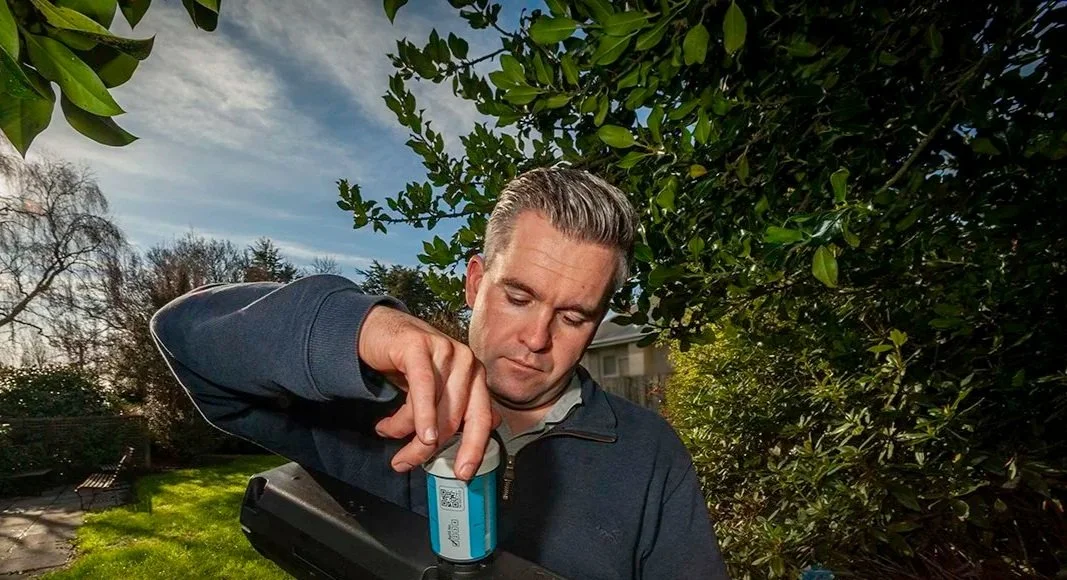
Tom Agnew with a ZIP H2Lure
Innovation’s like that, says Agnew, Development Director at Zero Invasive Predators (ZIP). You start with a problem, imagine the solution, then work backwards. In his case, that problem was coaxing rats and possums out from hiding to somewhere he could see them.
ZIP specialises in landscape-scale predator elimination, using a mix of aerial toxins and ground-based traps and bait stations. Once a site’s treated, the job is to find any survivors, and to detect other pests invading from outside the site. ZIP does that with ranks of smart thermal cameras that can recognise predator species and send a photo of them to a ranger’s cellphone. But Agnew can’t just put cameras out there and hope something blunders into shot. He needs to tempt it into frame with something delicious.
Cue egg mayonnaise—preferably Best Foods whole egg mayonnaise. Rats, stoats and possums are nuts for it, because they crave fat and protein above all else. Mayonnaise offers them all the calories they could hope for, and if you keep the sun off it, it stays fresh for months. Best of all for Agnew, it doesn’t separate or congeal; it remains runny, and that’s where the revolution starts...
Back in 2016, he explains, ‘We were running a trap network at a trial site called Bottle Rock, in the Marlborough Sounds. We probably had a couple of thousand traps out, and a team of rangers serviced each one every couple of weeks. Their task was to empty every trap, and swap in fresh lure.’ It was a massive amount of work, and ZIP’s development team soon realised that a device which could automatically serve up a dob of fresh mayonnaise every 24 hours, and do that for months at a time, would help make broad-scale pest control affordable.
‘Our engineering team developed a rather mechanical answer,’ says Agnew, ‘called the ZIP MotoLure.’ Inside a kea and rat-proof stainless steel housing, a battery-driven motor wound a threaded rod at timed increments into a syringe filled with mayonnaise. ‘That deposited fresh lure at the base of a tree in front of a camera, or inside a trap box—wherever it’s needed.
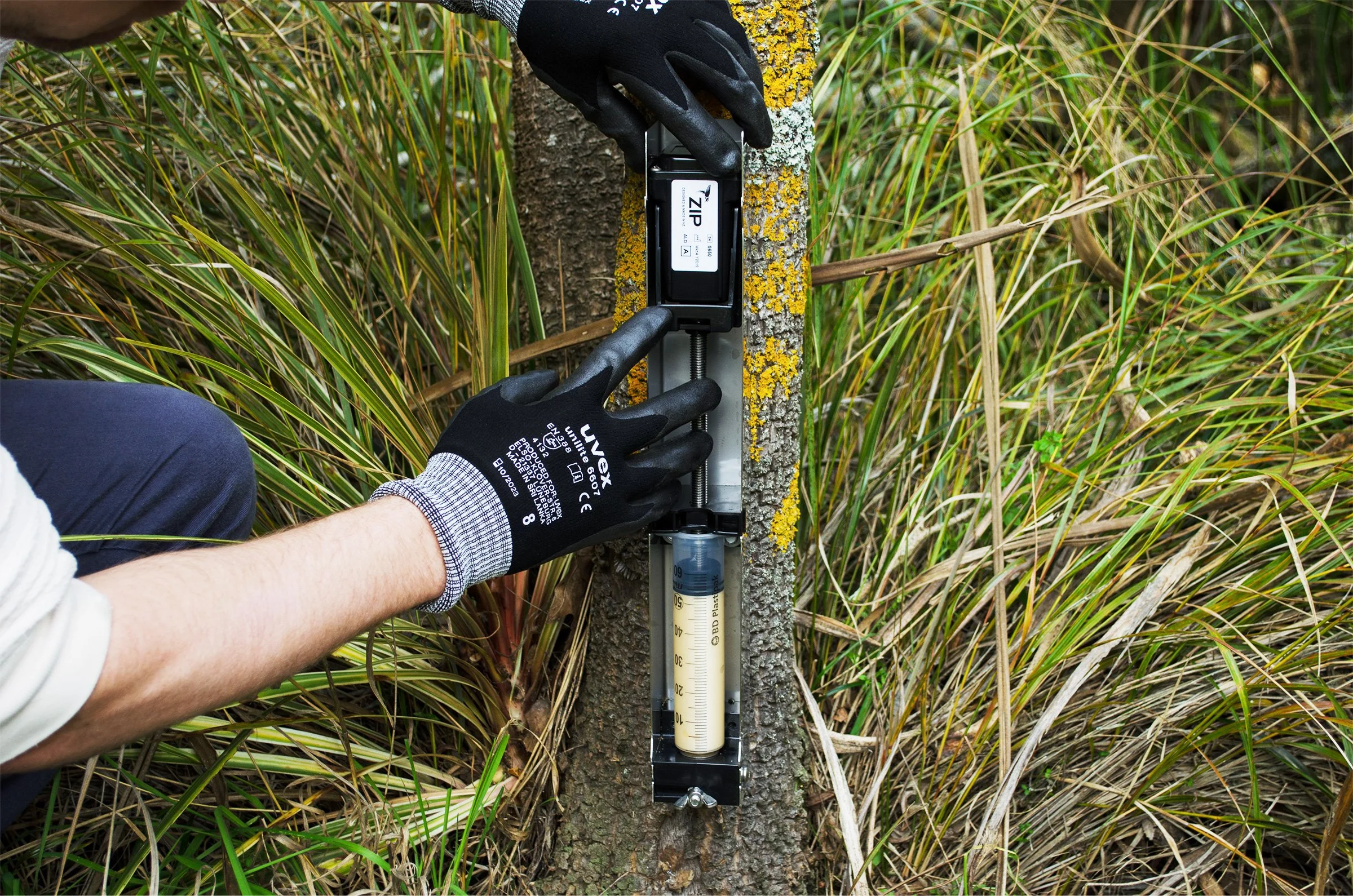
A mayonnaise-dispensing ZIP Motolure being installed on a tree.
‘We had a lot of control over that system. We could programme a MotoLure to dispense a measured dose of mayonnaise at any given time time of day, so that when rats and possums turned up after dark, there was something fresh waiting for them. And we had a device that could go for 12 months before it needed to be re-serviced.’
It was a big leap forward, he says, ‘But it was electronically complex. There was a bunch of stuff that could potentially go wrong, and because of that complexity, MotoLures were quite expensive. When you’re putting out lots per hectare, the cost soon gets prohibitive.’
Back to the drawing board: ZIP needed something that did the job of the MotoLure, but was cheaper, lighter and more reliable. The solution lay inside heavy machinery all over the world—an electrochemical lubricator, that automatically dispenses grease in timed, measured doses. It combines an electrolyte with certain metals, creating a hydrogen reaction. The expansion of that hydrogen gas provides the propulsion to push the grease out of a cartridge over time (a similar micro-device can now be implanted inside peoples’ bodies to administer medications on schedule or demand).
Agnew regards the tiny button in his hand: ‘It looks very simple, but it would’ve taken engineers years to develop. We’ve just adapted it to attract rats, stoats and possums.’ He produces the ZIP H2 Lure. For the most part, it’s a plastic jar—the revolution happens in the lid, which contains a battery and a small hydrogen cell. A printed circuit board regulates the rate of hydrogen gas released from the cell, which gives Agnew a choice of dispensing applications.
Turns out physics doesn’t see much difference between grease and mayonnaise: the gas pressurises a plunger that in turn pushes mayonnaise out of the jar. The plunger wears a thin coat of food grade grease that ensures the gas can’t leak past it. By adjusting the amount of current flowing through the cell, an H2 Lure will silently beaver away untended for two, six or even 12 months.
And there’s the revolution. ZIP works over vast landscapes—Predator Free South Westland is 110,000 hectares in size—which means there are hard limits to what human labour can affordably do. Apart from anything else, the sheer costs of labour prohibit the sort of geographical scale that Predator Free Aotearoa demands. Only smart, durable machines can get it done, and the H2 Lure is designed to attach to a wider system of ZIP devices. Mounted to a tree (in a kea-proof shroud), it can draw pests into the vision of a monitoring camera. Or it can mount into the top of a cage trap. It also screws into the top of the ZIPinn, a ground-breaking capture trap that kills using CO2. In the future, ZIP hope to use this same technology to dispense gel-based rat toxins into bait stations to reduce the labour cost of ground-based rat elimination.
Pest animals—rats, especially—can be neophobic, which means they’re obsessively wary of new things, but because mayonnaise is non-toxic, even the most leery come to ‘trust’ it, making them much more likely to enter traps and detection devices.
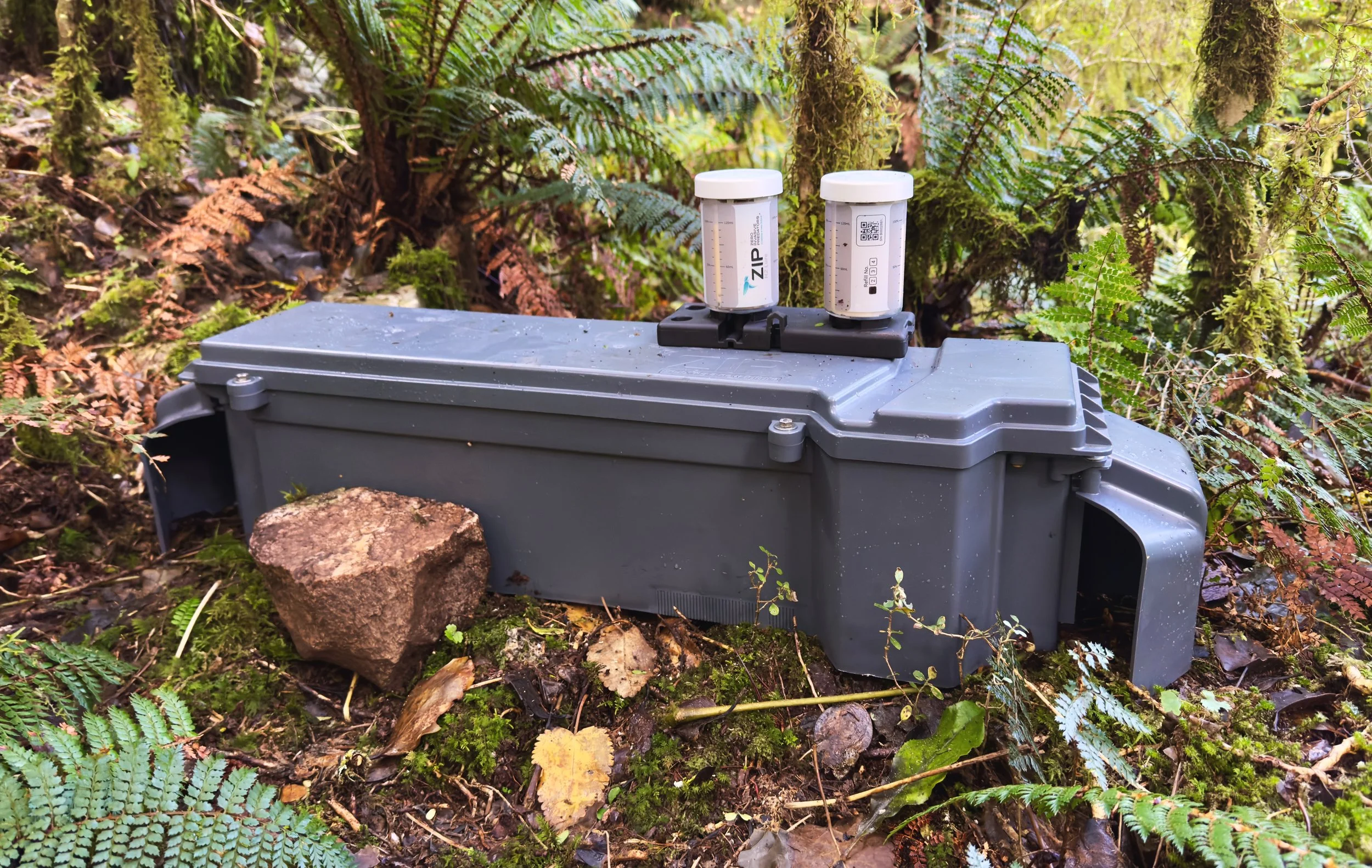
A ZIP H2Lure installed on a ZIPInn.
Another ZIP project, Predator Free Rakiura, means to eliminate possums, feral cats, hedgehogs and three species of rat from the island, and to stop them coming back, which will need an agile and watchful biosecurity system. A network of H2 Lures and cameras either side of Foveaux Strait will make it much harder for a rodent to slip past unnoticed. ‘As long as we’re putting out something fresh that we know is palatable to animals,’ says Agnew, ‘we only need one interaction with that AI camera and then we know they’re around.’
Eradication means finding every last pest, which sounded like a pipe dream only five years ago. But as long as they keep going crazy for condiments, the H2 Lure will help us do exactly that, one splodge at a time.