
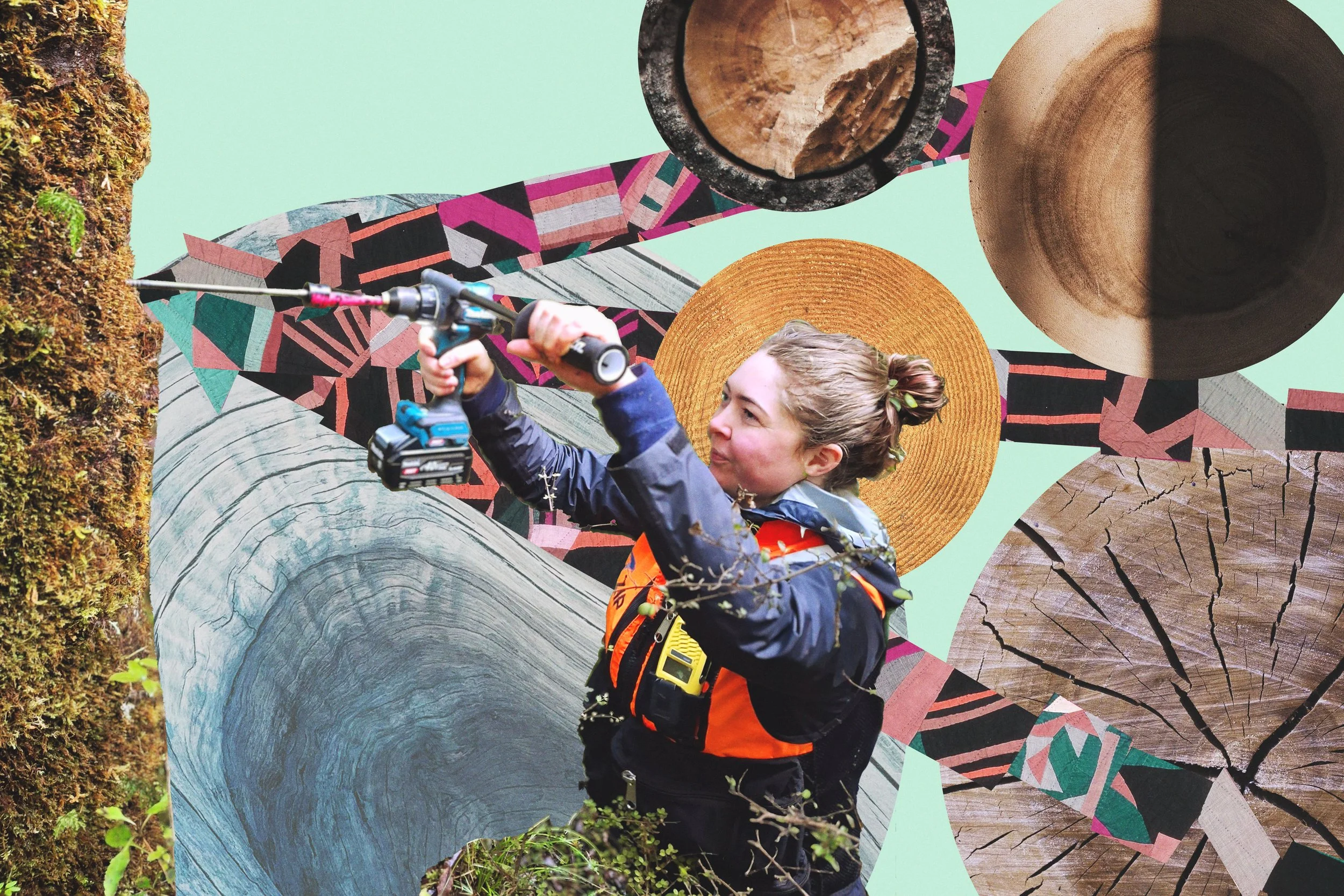
Next time you’re stacking firewood, take a moment to read the stories that tree rings tell...
Every year, trees grow a new layer between their bark and their trunk. The wood they add in spring is made of larger cells, so it grows faster. Its colour is lighter. In the late summer, when growth slows down, the wood has smaller cells, which makes it darker. The result is a bullseye: concentric bands of alternating light and dark rings, and they’re a history book.
Scientists can read the stories of living trees by taking slender core samples from their trunks (a bit like taking a biopsy from a human). This is the study of dendrochronology, and it not only tells us how old the tree is, but the story of its life. Wide annual rings record the tree’s halcyon days: times of plenty. Narrow rings tell you about the struggles it faced with drought, frosts, fire or disease.
And it’s those narrow bands that Maggie Nichols is interested in. These core samples have come from living kāmahi trees on Whenua Hou, an island wildlife sanctuary off the west coast of Rakiura. It’s a sanctuary because it has no introduced pests — at least, not any more. There used to be possums there, and even if there were no human records of that, the trees remember it like it was yesterday. How do we know? It’s etched in their essence.
Nichols, a senior ecologist at ZIP’s Lincoln research facility, can trace her finger along a tree core and point to 1986. To the left of that year, towards the trunk’s centre, the growth rings are narrower, crowded together. They speak to her of stress, of lost potential. To the right, out towards the present day, the rings widen where the tree enjoyed better growth. 1986 was the year Whenua Hou was finally rid of possums.
Nichols is testing a hypothesis. She suspects that constant browsing by possums stifles tree growth. That they spend all their precious resources simply trying to replace the leaves they’ve lost, rather than laying down wood in their trunk.
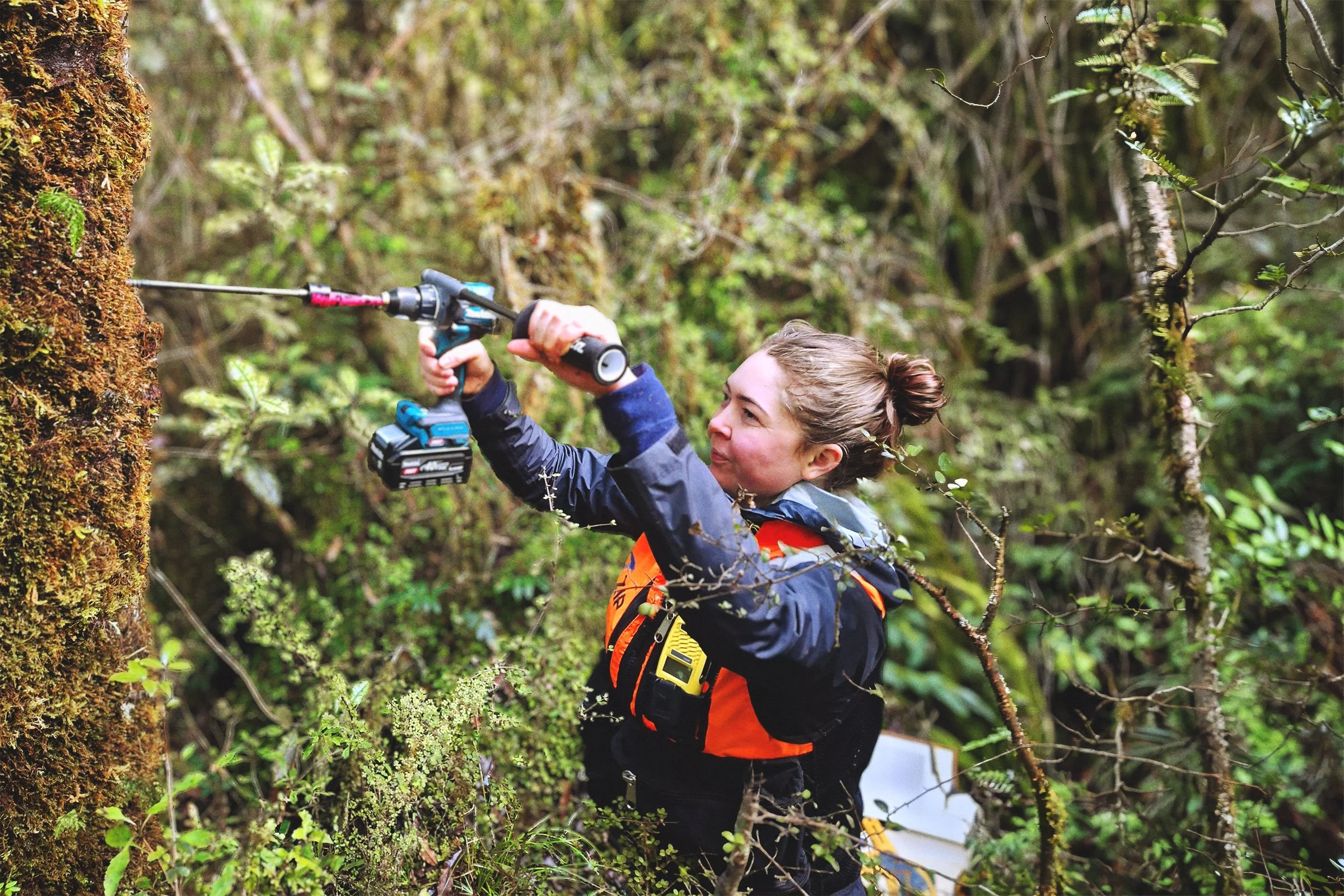
Core sampling has been embraced by plantation forestry companies the world over, but it hasn’t been applied to Aotearoa’s native forests before. Nichols thinks that’s down to concerns it might harm the trees, but she points out that it leaves a hole no bigger than a huhu grub burrow. If anything, coring looks harder on her: she must wield a hefty power drill, usually above her head, in awkward terrain. “It’s hard work. And with with rātā, while you can drill into them, the drill doesn’t have enough torque to get the sample back out.
“So you have to retrieve it by hand, one turn at a time; put your foot into the tree while someone supports you.”
Forestry managers use purpose-built software – CooRecorder and dfoliatR – to analyse cores for things like the impact of insects on wood production. That software, says Nichols, removes the noise of other environmental variables: “Anything remaining that looks like a severe change for that tree, I’m going to assume was down to defoliation, because there was nothing else that could have caused it.”
She points to a software-generated graphic. On the left, the tree cores for a given time period. She singles one out: “This is the life of this kāmahi – its whakapapa. It started in the 1800s.” To the right, horizontal lines of three different colours: blue is the colour of good times, when the tree put on plenty of growth. Yellow lines tell of middling fortunes, when the tree, developmentally speaking, was going nowhere. Red lines tell Nichols that she’s onto something: they span the years the tree went backwards. “We know that possums were on Whenua Hou from 1905 until eradication in 1986, and that they love eating kāmahi trees. So the software’s looked for adverse events throughout that period. And it just so happens we have a lot of red lines in those times of high possum density.”
And sure enough, post-1986, the corresponding growth rings in the core sample thicken. The lines are overwhelmingly blue as the tree rallies from decades of intensive browsing. In places, though, there are still red lines, even after the possums have gone: “Some trees never recover”, says Nichols. “These are old. They might be just giving up at this point.”
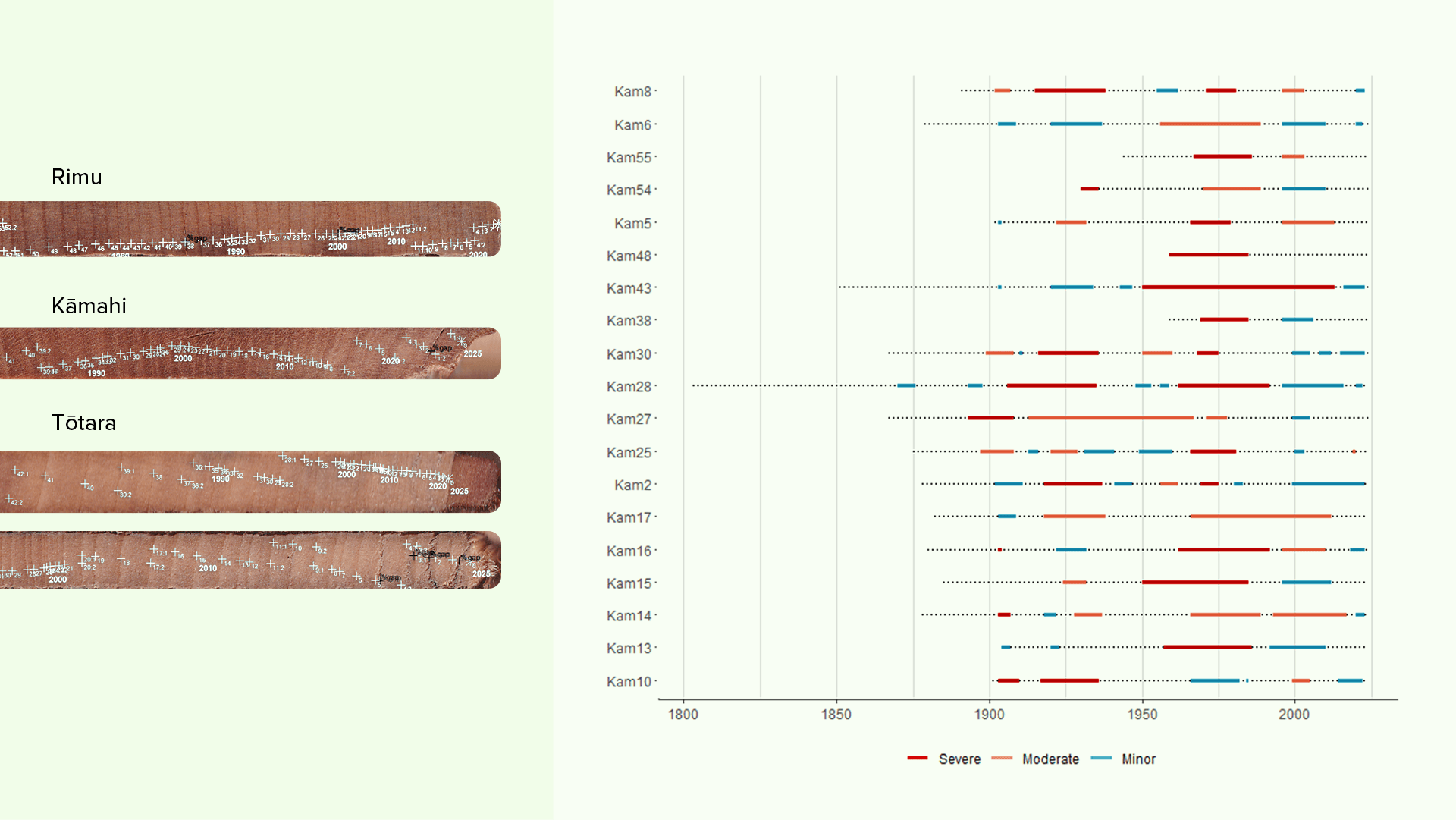
Above: Special software can read a core sample (L) and tell researchers the life story of that tree (R): the years of rain and plenty, and the hard times, when it was beset by drought — or possums.
She also takes core samples from trees that possums don’t eat. Any growth discrepancy in those, she says, “is natural. That gives us the background variability curve.” By comparing them with her kāmahi core samples, she can better pick out possum impacts.
Kāmahi tend to be slow-growing and slender “so they have really dense wood. The tradeoff is that dense wood’s harder to read, because it’s very dark.” At the moment, around 10 per cent of kāmahi samples are too difficult to analyse. ZIP’s trying to solve that with ultra-fine industrial wood planers that can shave off slivers a single micron thick. Then researchers can put them under a microscope and interpret them with more confidence.
Places like Whenua Hou are gold for Nichols, because they give her the known dates of possum arrival and eradication, and a record of infestation in between which provides a good, long sample. The task now is to cross-check her results against those from other sites around the country.
If they prove her right, it could mean a boon for pest control funding. Trees need carbon to make roots, trunks and branches, and growth rings are a reliable measure of the amount of airborne carbon dioxide – the most abundant greenhouse gas – they’re absorbing. The healthier it is, the more carbon a tree sequesters, helping to mitigate the impacts of climate change. So ZIP is asking a broader research question: if we eliminate introduced browsers from a forest, does that forest then remove more carbon from the atmosphere?
If Nichols and her colleagues can prove the link between pest control and forest health, and if they can accurately measure that increase in stored carbon, it could mean that Aotearoa can trade that carbon on the global voluntary market, generating funding for more restoration work. The forest effectively pays us back for the cost of the pest control and helps fund the ongoing maintenance.
In the next installment, we’ll look at another ingenious way ZIP is getting answers to that question.