
Zero Invasive Predators (ZIP) established a pair of study sites in native forest in South Westland to compare the impact of introduced wild animals—and their control—on the structure of those sites, and their current carbon stocks.
One site is at South Ōkārito, and the other is at Weheka south. Weheka was the site of possum liberations between 1924 and 1930, and surveys reported high possum numbers and ‘striking vegetation damage’ by 1949. It has never received any concerted possum control.
By contrast, South Ōkārito has received intensive rat and possum control since 1998 by way of regular aerial 1080 operations.
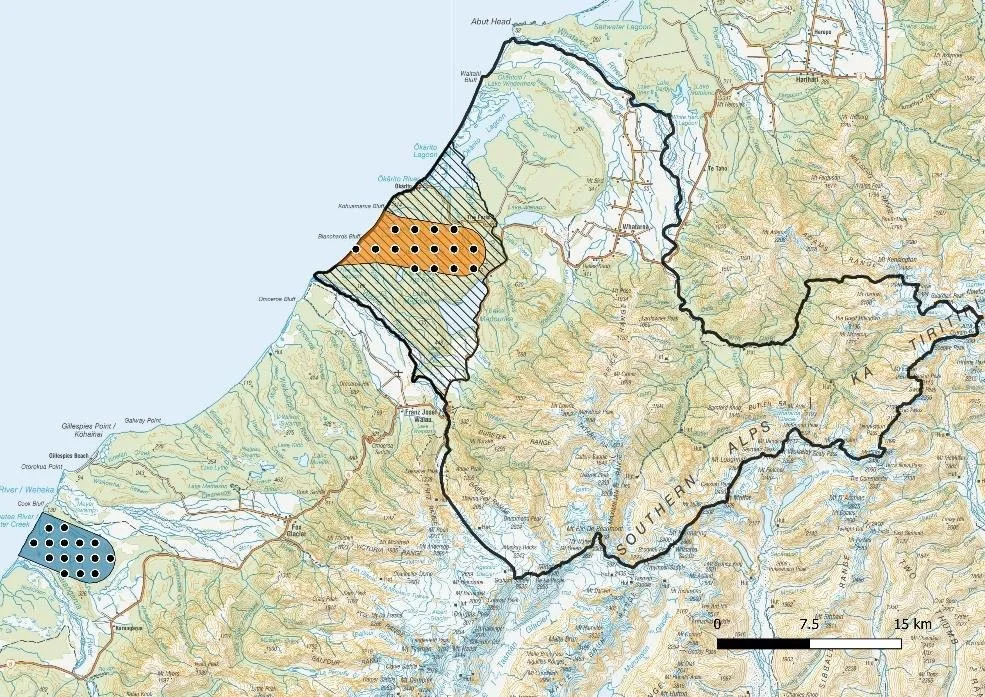
The South Ōkārito (orange) and Weheka South (blue) pair of sites, and the vegetation plots (black dots). The boundary of the Predator Free South Westland project is also shown (black outline)
Both sites host broadleaved-podocarp forests across similar landforms. Researchers randomly selected 15 plots at each site, and measured vegetation and associated carbon stocks.
That work provided a baseline for other measurements such as tree growth, carbon flux, and vegetation condition which will be reported separately.
Tree measurements and plot sizes were consistent with the New Zealand Natural Forest Inventory methodology, but the team increased plot density to one every 2.56 km2. They used circular plots, recording all tree positions using bearings and distances from each plot centre, which allowed for better matching with aerial imaging data.
What they found
Overall, above-ground carbon stocks at South Ōkārito and Weheka South were broadly similar. Across possum-palatable species at Ōkārito, more carbon was stored in small trees between 2.5 cm to 10cm diameter at breast height (DBH) and larger trees greater than 60 cm DBH. At Weheka, more carbon was stored in unpalatable species greater than 60 cm DBH.
Seedlings and Saplings
Ōkārito had twice as many seedlings and saplings—both palatable and unpalatable. Counting in the regeneration tier, researchers recorded 1049 individuals smaller than 15 cm in the Ōkārito plots, compared with 519 at Weheka.
Kāmahi seedlings were much more common in Ōkārito (155) than Weheka (50), and seedlings of species such as fuchsia and southern rata—which possums target preferentially—were only found in Ōkārito
It’s well established that possums, rats, and deer hinder forest recruitment by eating shoots and leaves, which leads to slower growth or mortality. Rats consume vast numbers of seeds, preventing tree germination. Meanwhile, stoats kill the birds that help to spread seeds.
Conclusion
The plots have revealed a picture of forest structure and carbon storage, allowing for a comparison between a pest-managed site (Ōkārito) and an unmanaged one (Weheka).
There is a noticeable difference in regeneration between the two: Weheka has fewer seedlings, and the dominant species are those that possums and deer do not like to eat. That can lead to a shift in forest composition, away from palatable species, some of which have denser wood than unpalatable ones.
Paradoxically, carbon stocks are currently higher in Weheka than Ōkārito. This is because the site has more large trees—mostly podocarps—that browsers don’t like to eat.
By comparing these sites, ZIP researchers can test the hypothesis that forests receiving wild animal control are able to sequester more carbon. If that proves correct, and that extra carbon can be traded, it could provide valuable funding for further conservation work.